Pages

Rebecca McCormick. Powered by Blogger.
Showing posts with label in translation. Show all posts

What You Are Looking For Is In the Library by Michiko Aoyama - Review

Sunday, March 8, 2026


This was one of the books that I got in the swap I did at Christmas, where the person I was swapping with was actually my friend Sarah Beth, which was really nice because it meant we knew each other and it was nice to choose books for Sarah Beth and really lovely to receive books that they really rate. I wasn't sure about this one at all, but was obviously willing to give it a go. My friend Stacey had also read this one and said I should get to it, so I did. As a reminder, I was trying to read all the books I got as gifts for Xmas in February, and I managed it! I'm thrilled that I did this, but it's not even the end of February and I have finished all five books! 

Anyway, this book. It is a book in translation which I always really like to read, although I don't get to many. This one is translated really beautifully which I think added to my enjoyment of the book. 

The book has five different protagonists, all of whom are struggling with something in their lives. They each end up in this one community library, either accidentally or because they're encouraged to go. There, this mysterious librarian called Ms Komachi, who sits needle felting in a little cubby by herself, will find for them several books. Among them will be a curve ball, something they weren't expecting, but which gives them exactly what they need in life. 

The first person is a young woman who works as a sales assistant who needs a push to educate herself a little better. She also makes some kind of rice ball things and maybe ends up starting a relationship with someone she works with. The second person is an accountant - a boring, safe life, but he really wishes to open an antiques store. He has his reasons for that, from his past. Some of his story ends up being reflected in someone else's story further on, too. I liked how all five people's lives were interwoven in this way for the reader to know even if the protagonists themselves don't realise it. 

The third person in the book had my favourite story. She used to be a magazine editor but then got pregnant, and was replaced while she was on maternity leave. She is struggling with life now - it's busy, she has to think about her daughter and deal with all the admin, etc. Her husband is trying, but she feels very alone. She's forty, and I just really liked her story arc. I like how her little section ended up, too. It felt very real for a lot of forty year olds. 

The fourth person is a manga artist, a young man who needs the library to help him learn new things. He's not in education or employment and he's flailing a bit. I liked him, and the fifth person, who is newly retired and isn't sure what to do with himself. 

As I say, all the stories do interweave a bit, in a really clever way. I did mostly like this book, but found it drifted a little bit. I'm giving it three and a half out of five - it didn't quite get to four stars but it was close. 

Convenience Store Woman by Sayaka Murata - Review

Wednesday, January 29, 2025


I can't even remember where I first heard about this book, but it was a while ago, and I feel like a lot of the bookstagrammers I follow have read it. I added it to my wishlist ages ago and one of my Secret Santas this year sent it to me. I'm really glad they picked it for me; I do keep my wishlist up to date and I'm glad I left this on it for so long because I really enjoyed it and liked reading it. I would read something else by the same author, for sure. 

So Keiko is thirty six years old and she lives by herself in a studio apartment. She works in a convenience store. She has worked there since she was eighteen. She really likes the routine of it, she likes knowing what she should be doing, she likes working out what the weather will mean for what they will sell. She has known since childhood that she is 'strange', so she learns social mores and ways of being from her coworkers. A lot of them are young, student types, and those her age tend to be management. Her parents wish she would get a 'real' job or at least settle down, but she's happy in her lane. 

She is close to her sister, who has just had a baby, and some of her sister's friends. One day she mentions a coworker, Shiraha, to them, and they are overjoyed for her, thinking she's finally met someone. Shiraha needs somewhere to stay after getting fired, and so Keiko invites him to stay with her. Keiko's life is changed but not necessarily for the better... 

I think Keiko is definitely autistic, and I think someone needs to diagnose her maybe and get her some support. I read a negative review of this book which said it was poking fun at autistic people but I really don't agree with that at all. I think Keiko is unapologetically herself and gets even more comfortable with that towards the end of the book. There's a lot about society's expectations of her as a woman nearing forty but I think it's fair to say that she just doesn't care. She's happy with her life and that's fine. 

I'm giving this four out five. I liked it a lot and would recommend it. 

A Meal in Winter by Hubert Mingarelli - Review

Wednesday, September 6, 2023

This was another of the novellas that I had seen in Waterstones in July and then ordered from the library. I took it away on holiday with me when I finished Death of a Bookseller so that I knew I would have something else to pick up. It's only 150 pages long so didn't take me long to read. I'm glad I didn't buy this as I definitely wouldn't read it again but I do like having read it, if that makes sense. 

So the story is about three Nazis, members of a Jew killing death squad, who, stationed in Poland in an extremely cold winter during World War II, leave their barracks and go out to try to find a Jew to take back to kill. They have a harsh commander and don't want to stand outside in the cold killing Jews who have been brought back the previous day, so they go above their commander's head and ask for permission to leave the barracks first thing in the morning. They are given permission so they head out in the freezing cold and walk for a long time. It's hard to understand the main character very much, but you do get more of a look at his companions. One of them is really worried about his wife and son at home, but the narrator has the benefit of knowing that he will die only a few months later. The other one is called Bauer and definitely seems like the most Nazi of the three - he comes across as hard and sadistic. 

The three discover a Jew hiding in a hole in the forest and they walk with him towards an abandoned hovel. The narrator is scathing towards the Polish owners of the hovel, as well as towards the Jew, aptly showing his hatred towards any number of people (please don't forget he is a Nazi!!!), but he is kind of moved by an embroidered snowflake on the Jew's hat and the idea that his mother may have made the hat for him. They put the Jew into the store room of the house and try to get the stove working. There is no fuel so the Nazis have to burn the door in the house, etc. They have some cornmeal that they want to make into a soup, and then it turns out that Bauer stole some provisions from the barracks before they left, meaning they can make a delicious broth. The rest of the novella is taken up by this simple act. But will they share their food with the Jew? What will they do with the Polish soldier who also turns up? 

It is a really tightly wound little book with a lot of drama packed in and a lot of tension. I'm not much into books which give sympathy to Nazis - for example those whole Tattooist of Auschwitz books and others like them - so I was a bit worried going into this. But on the whole I think these soldiers show themselves up for exactly who they are; it really works. I'm giving this three out of five. 

Heatwave by Victor Jestin, translated by Sam Taylor - Review

Monday, February 13, 2023

I picked this book up in Waterstones a few weeks back, because I was intrigued by the premise of it. I started it at the end of January, and it just took me a couple of days to read because it's not very long, it's a novella really. I don't often read books in translation but every now and then I do, and I always really enjoy them when I do. I did feel like here there were a few phrases that seemed to have been translated a little oddly, but mostly I liked it.

The book is set in France, in Landes in south west France, on the type of campsite where I spent an awful lot of my formative years so could imagine perfectly. While the book is obviously set in pretty much present day, which is obvious due to the use of mobile phones/camera phones, it has a feeling that it could be set basically any time from the 1970s until now. It's got a real timeless feeling, like you might be at the campsite forever, every summer, for the rest of your life. 

So, the story. Leonard is a shy seventeen year old, plagued by body insecurities and the fact that he can't seem to talk to girls. He is on holiday with his parents, his fifteen year old brother, and his younger sister. Oh and their dog, Bubble. At the beginning of the novel Leo watches as Oscar, a popular boy, strangles himself to death on the ropes of a swing. Leo doesn't try to help, and doesn't then raise the alarm when Oscar has died. He then decides to bury Oscar's body in a sand dune on the beach. It's late, and all the parties have finished, so no one sees him do it. Leo goes to bed, ready for his family's last day at the camp.

On the Saturday, Leo feels immediately guilty over Oscar, feels Oscar's body calling to him, and feels awful throughout the day. He talks to two girls, one of whom was kind of having a thing with Oscar. He speaks to Oscar's mum, who is not at first alarmed by Oscar's disappearance, but who reports him missing later on. The book is set over twenty four hours and I really liked it. I'm giving it four out of five. 

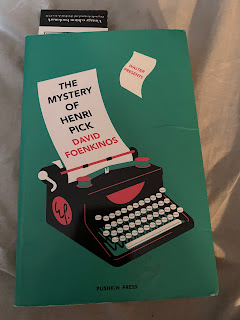
The Mystery of Henri Pick by David Foenkinos - Review

Monday, April 4, 2022


This was our March choice for my book club. I'm not sure who chose it, but I was a bit apprehensive about the book but ended up really enjoying it. It is a bizarre book though! I think most people will like it but I bet there's a couple in my book club who don't!

So this book is a translation of the original French, so of course there may be some things that aren't exactly as the author intended, but I quite like that. It's also a very meta book, it self-references several times. It's also very tongue in cheek, which I liked. The narration is a little odd too, at several points there are footnotes in the book where the narrator becomes completely omniscient and tells the reader something that will happen later. I don't often read books like this, but I don't mind it. 

The book is set in Brittany, near Dinan, which is somewhere I've been so I could imagine it perfectly which I liked. There is a library in a town called Crozon, and the librarian there has set up a library for writers' discarded manuscripts. Based on something American author Richard Brautigan really did, the librarian, Gourvec, has set up a place for authors to drop off their unpublished manuscripts. His only rule is that they must be dropped off in person. Courvec dies, and his assistant, who I think is called Marion, takes over the library.

Meanwhile, an author called Frederic has written an underwhelming book and is feeling despondent about it. His girlfriend Delphine is an editor for a publishing house; she is who published him. He is determined to write a better novel. He accompanies Delphine to Brittany, where she is from. Her parents mention Gourvec's library, so Frederic and Delphine head across. 

There they find a manuscript that they think is brilliant. It has the name Henri Pick on it. Some digging finds that he is dead, and that he was the owner of a pizzeria in town, which he owned with his wife Madeleine. Delphine wants to publish the book, so they visit Madeleine to ask her permission. 

Madeleine is surprised that her husband wrote a book, as she never saw him read anything and spent most of her time with him. She agrees that he could have written in the early mornings. She and her daughter Josephine, owner of a lingerie shop in Rennes, decide that the book can be published. 

It is, and both women appear on TV and in newspapers to talk about the book. The book is a huge success and the library grows extensively as more and more people visit it. But some people wonder whether Henri could have written such a masterpiece at all. A journalist called Rouche heads to Brittany to investigate. He is in the middle of breaking up with his girlfriend, which is an interesting plot point but ultimately not relevant to the story. That's NOT the only plot point like that, but I liked it!

It took me a day or two to get into the book but once I did I really liked it. It's boggling and it changes direction a lot, which I also liked. I would recommend it for sure, and I'm giving it four out of five. 

Small Country by Gael Faye - Review

Saturday, March 23, 2019

I bought this book from Our Liberty Box which was a black owned business that sold things from Africa and the African diaspora. It doesn't appear to be working now, but I saw an advert for something last year and bought some Christmas gifts from there. I also bought myself this book and another.

This book is about the Rwandan genocide, the civil war between the Hutus and the Tutsis in the 1990s. So if that's something that will distress you, don't read this book. However, I didn't find it too graphic. There is some violence, of course, and some mental illness which may also be distressing. I think that for an older teen it would be a perfectly appropriate book, however, especially for a teen interested in this kind of history.

The story centres on Gaby, a young boy living in Burundi. He is mixed race - his dad is French, and white, and his mum is Rwandan. She has been living in exile for many years in Burundi as she's a Tutsi and the situation in Rwanda has been tense for years. She sometimes gets to visit her aunt in Rwanda, who has four children, with whom Gaby and his sister Ana are close.

Gaby has four friends who live on his street, and avoids local bully Francis. As tensions rise, Gaby's maman leaves the family, and the men who work in his house are under threat.

I liked this a lot, I thought the point of view of a young boy was a really good way of showing the genocide. This book was translated from French but I don't think it showed. Gael Faye is a musician and this is his first novel, but I would definitely read something else by him in the future.


Blogger news

Blogroll

Most Read

Tags