Pages

Rebecca McCormick. Powered by Blogger.
Showing posts with label religion. Show all posts

Cuddy by Benjamin Myers - Review

Tuesday, February 10, 2026


This was the book club choice for January and I got a Readers Group copy from the library in like November or something, I dunno, a long time ago. The book was a bit intimidating as it seemed long, and I was concentrating on queer books in January, so I decided to listen to the audiobook instead. Generally in a week I might have a couple of hours where I'm driving and can listen to an audiobook, so I knew I could finish it before the 21st when our meeting was. But then I ended up finishing it in only a couple of weeks as I really liked it and ending up listening to it while I was working too. Listening to it was a joy too because three of the four main parts were narrated by friendly Geordies which was nice. My experience with this made me decide to listen to February's choice for book club, too! More on that later... 

So, Cuddy is the nickname of St Cuthbert, who is the patron saint of Durham Cathedral. This was about the sum total of my knowledge about Cuthbert before I read this book (audiobooks count as reading and it's ableist to suggest otherwise as some people CAN'T read paper or electronic books!) and I expected it to be a novel about him and his life, not dissimilar to Haven by Emma Donoghue which I read back in 2023. Margaret at book club thought the same thing, but no. This is not really a book about St Cuthbert. 

There's a lot of scene setting with quotes about Cuthbert's life and the settling of Durham and the start of the building of the cathedral. I found this a bit dull but I made my way through it to Book 1.

Book 1 is about Ediva, a young woman who is with the band of monks that are taking care of Cuthbert's coffin. When Cuthbert died his body was put inot a stone coffin and removed from Lindisfarne, where he had lived, to the mainland, because of the Viking invaders. Ediva is cook, healer, general dogsbody for the monks. She is somewhat friendly with a young boy, who is also an outsider from the monks, and who has large owl eyes. He is a recurring character through the book, in an odd way. Ediva has visions of where they will set Cuthbert's body down and build a chapel for him - there will be a clearing with a cow. Indeed, this comes to pass, at the bend in the river Wear where Durham Cathedral now sits. 

I liked Ediva; it was interesting to hear her back story and her place within the bank of monks. I liked the faith that they all had that they would find a place worthy of Cuthbert's shrine. I love religious stories like this because I just don't have  that type of faith. This book is set in the tenth century. 

Book 2 was my favourite of the four and lots of people at book club felt the same. It could have been a book in its own right! It's about Eda, a woman who is married to Fletcher Bullard, an archer for the king. This book is set in the 1300s. Fletcher is great at his job, a great archer, well respected etc, but he's also abusive towards Eda. He kicked her so hard once that she has been unable to bear children. She likes it when Fletcher is away from home fighting. She makes beer and takes it to the stonemasons working on the walls of the cathedral. There she meets Francis Rolfe, a mason, who woos her and charms her. I thought that the story would end really badly but loved how it worked out. This part was written in the second person which really gave it immediacy and drew us towards it. 

Book 3 was maybe my least favourite but I still liked it a lot. It's a ghost story set in the 1850s or something like that. A professor at Oxford is invited to Durham to be there when some clerics open Cuthbert's tomb. There's a myth that Cuthbert's body has never decayed and that in the stone coffin it is still whole. The professor is disdainful of the north but arrives in Durham and is greeted by a boy with eyes like an owl's who leads him to his lodgings. But his host, one of the vicars involved, doesn't know this boy. The professor is haunted at night by strange singing in his room. This part owes a lot to writing like The Woman in Black and so on. I didn't love it but it is compelling. 

Book 4 is about Michael. It's set in 2019. Michael is around nineteen years old and is caring for his dying mother. He works as a casual labourer doing back breaking work and he budgets every penny - eating nothing but Pot Noodles - while also kind of wishing for something outside of himself. He gets a job working in the cathedral where talented masons and so on are working on repairs to the ancient building. His life is very much a portrait of Tory Britain at the time which I thought was very effective. I felt really sorry for Michael. At book club, we liked the ending too, and we liked the through motif of Cuthbert spraking to the protagonist of each book. 

In all I'm giving this five out of five, I absolutely loved it and it was a joy to keep me company on my drives! 

The Year of the Witching by Alexis Henderson - Review

Thursday, March 16, 2023


Early in 2023 I asked some of my closest friends what their favourite books of 2022 were, thinking I would give them a go. That way I get to read something that I wouldn't normally pick up. I like being forced out of my comfort zone by books, and this definitely was that. I would never have picked this up by myself but I really enjoyed it, so I'm calling this a win.

First of all, I can't decide when exactly this book is set. It's got a mediaeval witch hunting vibe to it, but the cult in question says it's existed for a thousand years, and it's not exactly mainstream religion, which would mean it isn't any of the more modern cults. I was expecting to find out, but in actuality I think it's set outside of our reality, but in a world which is all too recognisable if you know anything about religious cults. I actually liked that I didn't find out. The whole novel has a vibe of that film The Village by M Night Shyamalan, which I also liked, but I was expecting there to be a twist like in the film, and there wasn't. Oh well, I tried!

Anyway, Immanuelle is sixteen years old and lives with her grandparents, Martha and Abram, and Abram's second wife Anna, and their children, Honor and Glory. This would make Honor and Glory Immanuelle's aunts, but she calls them her sisters. They are both younger than her so I understand they've been raised as sisters, but even so, it annoyed me. Immanuelle's mother, Miriam, died in childbirth with Immanuelle. Immanuelle's father was Daniel Ward, someone who came from the Outskirts of the place Immanuelle lives, which is called Bethel. As the novel goes on it becomes clear that Daniel was Black and so are lots of people in the Outskirts, whereas everyone in Bethel is white. Miriam spent some time in the woods around Bethel while she was pregnant. She was adamant that she had lived in a cabin in the woods, but no one could ever find it. She was accused of witchcraft and of practicing witchcraft alongside the four witches who live in the woods: Lilith, Delilah, Jael, and Mercy. 

Immanuelle has always found herself drawn to the woods, even though she knows she must stay away from them. But she goes in, and meets the witches - the Lovers, Jael and Mercy, and then Delilah and Lilith. They give her her mother's journal, which contains details of Miriam's life, including the cabin she stayed in, and including portraits of Immanuelle's father. Immanuelle is scared by what she reads, especially because Miriam writes about four plagues which will hit Bethel. 

And then the first one does, a blood plague. All the water turns to blood, no one can drink. Crops fail. Immanuelle finally gets her monthly bleeding, which she's never got before. She knows how she can stop the curse, but she needs the help of Ezra. Ezra is the Prophet's son and heir, high up in Bethel's hierarchy. He has already given her a book and showed her that he's fond of her. This means that the Prophet is already wary of her. 

The Prophet is an old man, but he has many wives. This is partly where my confusion about when and where this book came from. There are mentions of the Father and the Holy Scriptures, but I don't think the religion is entirely meant to be Christianity, but I think it's supposed to reflect those ideals and history. It's so interesting! Immanuelle's friend, Leah, is chosen as the Prophet's new wife, and there is a huge ceremony in the cathedral for her. She is cut with the symbol of an 8 pointed star between her eyebrows, which shows her as a wife. Immanuelle tries to be happy for her friend, but then she discovers a secret about Leah and the Prophet... 

This book has a lot going on in it, and at the end I think it shows itself to be the perfect first novel in a trilogy. It's got an ending, but one which leads itself on to more, definitely. I would definitely read more set in this world as I really liked it - there isn't a lot of explanation which makes the reader extrapolate for themself which I like. It took me a bit of time to get into, but when I did I really got into it. I am giving this four out of five. 

Autoboyography by Christina Lauren - Review

Sunday, May 31, 2020


Where did I get it? It was a present from my partner a few weeks ago. I'd had it recommended by my friend Janet and asked my partner for it for an occasion. He bought me a couple of other books too! It's difficult to buy me books as I have so many but I had asked for these. 

What's it about? It's about a boy called Tanner who lives in Provo, Utah, which is like 90% Mormon. He is from California originally, but his parents moved the family to Utah a couple of years ago for his mom's job (she's a programmer). Tanner is bisexual and out to his family. However, their move to Utah meant that he had to stay closeted and not be out to anyone there, not even his best friend Autumn. He's about to start his last semester of high school, and Autumn dares him to take The Seminar, which is a class where each student writes a whole book in one semester. Last year, a boy called Sebastian took the class and sold his book, which is about to be published. 

And this year he's back to work as a mentor for the class. He's Mormon, the son of a bishop (which is like being a pastor or vicar). Tanner is not Mormon, or religious at all. His dad is Jewish, but pretty agnostic. His mum is ex-Mormon - she was raised in a Mormon family in California but left when her sister came out as a teenager and was cut off from the family. She's pretty antagonistic towards the LDS church (which I'm not criticising her for at all!). 

Tanner and Sebastian meet in Tanner's class and Tanner falls instantly in love. The two start to meet up to work on Tanner's book, and start a romantic relationship. Tanner's book, though, is all about Sebastian, so he can't turn it in without outing Sebastian. Tanner's parents are less than thrilled that the two are seeing each other, and stop them from being in Tanner's house. Clearly Sebastian's parents don't know. Autumn doesn't know. The two end up hiking the mountain in Provo a lot to make out there. 

I can't really talk about this book without giving my criticisms here. First of all, this book did not grip me for the first half at all. It took me three days to read the first half because I found it quite boring. There's no emotional connection between the two boys. Tanner falls in love instantly, but there's no compelling reason why. There's a LOT of chat between Tanner and his parents, but it's so saccharine my teeth hurt. They're supposedly so supportive, but then they're not allowing him to be his own self by being out? Why not support him to be out, even if only to a couple of close friends? And stand up for him? I dunno. 

What else? Well there's a few plot points that don't go anywhere. At one point, two girls possibly overhear Tanner talking about his relationship with Sebastian, and Tanner spends quite a bit of time fretting about it, but then literally nothing happens? Then there's a whole thing about prom, and whether Tanner and Autumn will go together, but then it's not mentioned ever again - not even whether they go or not. There are a lot of people mentioned, lots of friends and classmates of Tanner, but he speaks to literally none of them throughout the book. I swear one classmate started off as a boy and ended as a girl. Tanner is supposedly good friends with boys called Manny and Eric, but there's no on-page interaction between Tanner and Eric. There's just so much Sebastian! All the time! And thinking about Sebastian! All the time! 

Then there's the fact Autumn is in love with Tanner and he knows this, and he uses that as one reason to not tell her he's bi, which didn't overly make sense to me, but okay. There's a bit where she's trying on prom dresses - in a majority Mormon town, so you would think dresses would be all "modest" - and he kind of shames her for how much skin there's showing. Then there's a really ridiculous thing that happens between them, which -- I understood what happened, and why, and unlike some reviewers, I'm not criticising that. However, the reactions afterwards baffled me. Autumn apologises when she has no need to, and Tanner is kind of a dick about it to her. 

THEN there's stuff where, while Sebastian is struggling with his sexuality and what label to give it, which is totally fine and legit, but while he's doing that, he's rude to Tanner about being bisexual. He seems baffled that Tanner has been with girls, and I didn't like that at all. 

The whole book has quite a fanfic feel to it, which concentrates on the emo drama of falling in love with someone, and has a lot of ~deep~ conversations between characters, but little else. I didn't hate it - I like fanfiction and it can be done really well, of course. But I think if we're reading fanfic we forgive a lot more, and we already know the characters and probably already have an emotional connection to them. I didn't here, and I felt like the book suffered because of it. Tanner is pretty frustrating all the way through.

I did feel like the book gave a good depiction of Mormons and Mormon culture. It must be weird living as a non-religious person in such a religious culture, and I felt like that was well done. Everyone had a story there, and I liked how Sebastian struggled. He kept saying that he didn't feel like he was doing anything wrong, which I liked. 

I started off disliking the book, then liked the second half a lot, then read a few reviews the day after I finished and thought, oh yeah, that's a valid point. So I think it's a bit of a Marmite book. It has its good points, and it is cute and fanficcy, but it has a lot of bad points too. 

What age range is it for? 14+ 

Are any main characters LGBTQ+? Obviously. Like I say, I didn't think the stuff around bisexuality was done very well. 

Are any main characters people of colour? No. 

Are any main characters disabled either mentally or physically? No 

Is there any sex stuff? Yes, it's a little graphic. 

Are drugs mentioned or used? No 

Is there any talk of death? No I don't think so

Are there swear words? Maybe a couple. 

What criticisms do I have? See the many paragraphs above! 

Would I recommend the book? Maybe as a quick read yeah. 

Why did I choose to read it at this point in life? I just wanted to get to it. 

What do I think of the cover? It's cute, it shows you the autobiography part and it shows you the two boys hiking the mountain, too. 

What other books is it like? I thought it was similar to Two Boys Kissing by David Levithan

How many stars? Three out of five

Where is the book going now? I'll pass it on to someone who might love it more, I think!

Does My Head Look Big in This? by Randa Abdel-Fattah - Review

Sunday, February 17, 2019


Where did I get it? Penistone library a few weeks ago, I had to renew it actually as I hadn't got round to it in the three week loan period!

What's it about? I have to say first of all that I thought this book was new - certainly the copy I had was new to the library, so I assumed. It isn't - it was published in 2005, and I think it's obvious just how far YA publishing has come in thirteen years. I didn't like this book very much but I was compelled to keep reading it to the end because I wanted to know what happened.

Amal is the main character, she is sixteen and goes to high school in Melbourne. Right at the beginning of the book she decides to start the new school year wearing hijab full time. She's worn it before, including at her old Islamic school, but never full time. She knows it's going to attract a lot of comments and attention. There's Tia, a racist bully, to contend with, and Adam, who Amal has a crush on. 

She has two best friends from her Islamic school, Leila and Yasmeen. Leila is also a "full timer", ie she wears the hijab all the time out of the house, and her mum is determined to set her up with an eligible man instead of letting her go to university like she wants to. Yasmeen's family is mixed race - her mum is white, and is a convert to Islam. 

Amal also has two friends at school. Eileen is Japanese, although we don't learn too much about her, and Simone is white and overweight. They both stand up for her when she faces racism and negative comments. The three girls also end up becoming closer to Adam and to Josh, who has a crush on Simone. 

The storyline about Amal and her hijab and what it meant to her and what her religion meant to her was a good one. I liked how her decisions were shown, I liked how Islam was portrayed, and I liked what happened with Adam. I think that this storyline is great for any modern teen to read, whether they're in the UK or Australia or American, whether they're Muslim or not, whether they know people who wear hijab or not.

But. One of the subplots includes Simone's weight, and I just found this tiresome at best. She's constantly hounded by her family because of her weight, and she body shames herself and constantly diets and goes on about what she is or isn't eating. She isn't "really fat" though, which annoyed me because, what if she was??? I found this whole part so depressing and fat shaming, and I really think that if the book was published now it would have been edited to make this subplot better. 

What age range is it for? 13+ 

Are any main characters LGBTQ+? No. You'd think none of them had ever even considered anyone could be queer, which I also found annoying. 

Are any main characters people of colour? Obviously. There's a lot of discussion of race and culture, which I did like. 

Are any main characters disabled either mentally or physically? No 

Is there any sex stuff? No 

Are drugs mentioned or used? Marijuana I think may be mentioned? 

Is there any talk of death? No 

Are there swear words? No 

What criticisms do I have? See above 

Would I recommend the book? Honestly no. I think there's far better examples of Muslim teens

Why did I choose to read it at this point in life? I had picked it up in the library because I thought it was new, I was quite disappointed it wasn't. 

What other books is it like? It's a lot like Saints and Misfits by S K Ali only not as good. 

How many stars? Four out of ten 

Where is the book going now? Back to the library if I remember to take it!


After the Fire by Will Hill - Review

Saturday, October 14, 2017

Where did I get it? I bought it on Kindle when it was really cheap a few weeks ago. 

What's it about? Moonbeam is seventeen and right at the beginning of the book, there has been a fire at the compound she has lived in for most of her life. Moonbeam has been injured in the fire, and first wakes up in hospital, then in a secure unit. She begins to have therapy with Dr Hernandez, but doesn't trust him at first. But through the book we read about Moonbeam's life within The Lord's Legion, a cult in Texas. 

The cult was led by the charismatic Father John, a self-proclaimed prophet who took over from a looser, less rigid leader called Father Patrick. No one was allowed to leave the compound and John preached about the evilness of the world and the fight that would occur and bring about the end times. Moonbeam's mother had been Banished from the cult and Moonbeam was no longer allowed to talk about her. All the adults of the cult have died in the fire and Moonbeam is one of the eldest that is left.

After a few days with Dr Hernandez he is joined by an FBI agent, Agent Carlyle, who is part of the team investigating the Lord's Legion and the fire. Moonbeam doesn't trust either of them, but she tells more and more of the events that happened within the compound. After therapy each day she has group therapy with the rest of the children who remain, including Luke, who is angry that he isn't dead and hasn't been able to Ascend to Heaven with the adults, and her friend Honey. 

I really like reading about religious cults. I did Theology for my undergraduate degree and particularly enjoyed a module called Christian Communities, Sects, and Cults. The way that cults develop and the way they cut themselves off from the world is endlessly fascinating to me. Charismatic leaders like Father John fascinate me and I felt the author did a really excellent job of portraying him. 

There are a lot of parallels with the true events that happened to the Branch Davidians in the siege at Waco, parallels that Will Hill himself acknowledges at the end of the book. I felt like there were a few TOO many parallels, really, although Hill did a good job of trying to imagine what a survivor would feel like. There's also a lot of repetition in the book. I understand the decision to write the book set from "after" the fire, but it does mean that some things, like Moonbeam's distrust of the psychiatrist and the police, are gone over again and again. If the book was linear, this could've been avoided. 

Finally, I felt like the end was a little bit too neat. I liked Moonbeam and her story, and I think the setting of the cult was a really good one, but I didn't gel entirely with the book. 

What age range is it for? There's a lot of really heavy stuff including abuse and violence, so I'm going to say 16+ 

Are any main characters LGBTQ+? No 

Are any main characters people of colour? No, and I wish this had been addressed. Cults like the Branch Davidians are often exclusively white because of racist interpretations of the Bible and of racist ideas like keeping the believers 'pure'. It would have been an interesting side note. 

Are any main characters disabled either mentally or physically? Yes. 

Is there any sex stuff? There's sexual assault and abuse, so trigger warning 

Are drugs mentioned or used? No 

Is there any talk of death? Yes, lots, and trigger warning for suicide too. 

Are there swear words? Very few 

What criticisms do I have? I think I've covered them above! The book seemed to take me ages to read and I think that was mostly due to the repetition. I also felt there were places where there was too much telling and not enough showing. Like there's a few times when Moonbeam asks a question the doctor and Agent Carlyle about her mother or her friend Nate and is told they don't know anything. The next lines are something like "I believe him". But why? We're not shown in enough depth as to why, and that sort of frustrated me. 

Would I recommend the book? Yes, it is a really interesting story. 

Why did I choose to read it at this point in life? It's one of Zoella's current book club choices and I wanted to see what it was like for myself! 

What other books is it like? It's a lot like Seed by Lisa Heathfield which is also about a religious cult, but it's also a lot like Paper Butterflies by Lisa too. I'd be interested in more books like this. 


How many stars? I gave it four out of five on Goodreads so that would usually be eight out of ten, but... I 'm going to go for 7.5. I felt like there were good bits and bad bits, but it is overall a very strong novel. 

Seed by Lisa Heathfield - Review

Tuesday, November 1, 2016

Where did I get it? I bought it, I think it was on the Guardian YA shortlist earlier in the year? I'd seen it at YA Shot last year though, where my friend Sam bought it. 

What's it about? Pearl lives at Seed. Seed is a cult, run by Papa S, and where everyone is one big family and where everyone worships Mother Nature. Pearl doesn't know who her real mother is, because everyone just lives as one family, but she's close to Elizabeth, who is expecting another baby. She has siblings of her own age, Jack and Kate, and some younger ones, Bobby and Ruby. The elders, including Papa S, were, I think, the original founders of the cult.

At the beginning of the novel, Pearl gets her period for the first time, and is made to go into a dark hole in the ground as she becomes a woman. Later, she has to go to the Forgiveness Room for her impure thoughts, and she's also asked to become Papa S's Companion at one point too. 

Three newcomers arrive from the Outside - Linda, and her children Ellis and Sophie. Ellis and Pearl grow close and Ellis tells her the truth about some things at Seed, and begins to expose its dark heart.

Now, one thing you might not know about me is that my undergraduate degree is in Theology and Religious Studies, and that I am really fascinated with cults of all kinds. So a book like this is perfect for me. I actually wanted more background on Seed and its origins, but I understand that, from Pearl's point of view, there might not be much point in relaying that information, as she has lived her whole life in Seed and nothing about it is strange to her. I felt like putting Nature at the centre instead of God was a really good decision by Lisa as it seems a little bit less controversial. I believe Seed is going to have a sequel and I'd definitely be interested to read it. 

When I read Paper Butterflies it absolutely destroyed me. I finished it about 3am one morning and wanted to throw it out of the window! Last weekend, at YA Shot, I took Seed to get signed and said to Lisa that I hoped that Seed wouldn't break my heart the same way Paper Butterflies did. She promised me it wouldn't and, well, she lied! The ending absolutely did me in! I think there is a paucity to Lisa's writing which really adds to her work and which is in no way a criticism - it makes the reader work and makes the reader more invested in what happens to the characters. 

What age range is it for? 15+

Are any main characters LGBTQ+? No
Are any main characters people of colour? No
Are any main characters disabled either mentally or physically? Yes, I can't say more without giving away spoilers, but there's some violence and illness
Is there any sex stuff? No
Are drugs mentioned or used? No
Is there any talk of death? Yes, be aware
Are there swear words? No
Would I recommend the book? Yes, especially if the premise interests you
How many stars? Eight and a half out of ten, it's really good!
Where is the book going now? I'll keep it, because Lisa very nicely signed it for me!

What Was Never Said by Emma Craigie - Review

Saturday, June 18, 2016

Where did I get it? I bought it on Kindle, it was around £4.

What's it about? It's a novel about Female Genital Mutilation, which is what attracted me to buying the book in the first place. Zahra is Somali and at the beginning of the novel she is a little girl in Somalia, playing with her sister Rahma and their friend Yas. Then the cutter comes, and cuts both Rahma and Yas. Rahma dies from the procedure. The narrative then moves to Bristol, where Zahra's family is living, with her new little sister Samsam. One Friday evening, the cutter arrives, with her suitcase and in her black clothes. Zahra can't bear the idea of either herself or Sam being cut, so she runs away, taking Sam with her. 
What age range is it for? 14+ as it's a very sensitive subject. 
Are any main characters LGBTQ+? No
Are any main characters people of colour? Yes, most everyone is Somali in the novel, and Muslim (which most Somalis are)
Are any main characters disabled either mentally or physically? I'm not sure if being cut is a disability, but it's clear that Zahra is traumatised from what happened to her sister, and that Yas still lives with the after effects of being cut, too. 
Is there any sex stuff? No
Are drugs mentioned or used? No
Is there any talk of death? Yes. There's also stuff about the war in Somalia which caused the family to flee. Trigger warning for so much in this novel. It is very very sensitively done, though. 
Are there swear words? Not many 
Would I recommend the book? Yes. It's very short but I really liked Zahra and Sam and Yas. I loved how the novel ended - I felt it was the ending that it deserved. 
How many stars? Eight out of ten. 

The Whole Story of Half a Girl by Veera Hiranandani - Review

Tuesday, October 20, 2015


Where did I get it? I bought it

What's it about? Sonia has an Indian dad and a Jewish mum, and while she's always been at a private, Montessori type school, she's now in public school and learning how to deal with that, as well as how to deal with being asked questions like "what are you?" and "where are you from?" Her dad is quite ill mentally, which is skillfully done, and Sonia is growing up, challenging her parents' rules, and learning who her real friends are. 

What age range is it for? Anything from 10 - 13 I think. 

Are any main characters LGBTQ+? It's not mentioned

Are any main characters non-white? Yes, one of the main premises.  

Are any main characters disabled either mentally or physically? Yes as I mentioned, Sonia's dad has depression.

Is there any sex stuff? No 

Are drugs mentioned or used? No 

Is there any talk of death? Yes, and suicide. 

Are there swear words? No.

Would I recommend the book? Yes, it's a really excellent example of a diverse middle grade book.  

How many stars? 8 out of 10. I'd definitely read something else by this author. 

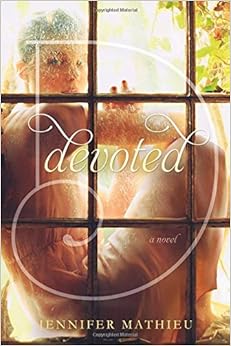
Devoted by Jennifer Mathieu - Review

Thursday, August 6, 2015

Where did I get it? Amazon, I pre-ordered it on the recommendation of my friend Angie, so had it in my hands on release day!


What's it about? Rachel is one of the oldest girls in her large, fundamentalist Christian family. She's homeschooled and expected to take care of her younger siblings. One Sunday in church, one of her peers is just back from Jesus Camp and repenting his sins. Rachel starts thinking, and remembers a girl who left the church but who has moved back to the area. Rachel isn't really allowed unsupervised access to the computer, but snatches time here and there to google the girl who left and read her blog. 

What age range is it for? It would depend on the teen, I think. Anything from 14+, but it would be useful to have a conversation about spiritual abuse. 

Are any main characters LGBTQ+? No.

Are any main characters non-white? No.

Are any main characters disabled either mentally or physically? No.

Is there any sex stuff? No.

Are drugs mentioned or used? No

Is there any talk of death? No.

Are there swear words? Very few. Like maybe two instances. 

Would I recommend the book? Yes, definitely

How many stars? An excellent 9 out of 10.

Where is the book going now? It's currently with my friend Lucinda who expressed an interest in reading it. 
 

Blogger news

Blogroll

Most Read

Tags